Christian Travelers Guides

Christian Travelers Guides

Saturday, March 31, 2012

The churches of Eisleben


Close to the house where Luther died is the parish Church of St. Andrew (Marktkirche St. Andreas) where Luther frequently preached when he visited the town. In fact, his last four sermons were preached here shortly before his death. This late Gothic hall church dominates the market square with its twin bell towers.

Originally built in the early middle ages as a Romanesque structure the church was renovated in the fifteenth century following a fire that almost completely destroyed the original building. The church was rebuilt to create a relatively rare triple-naved hall church. Inside this dimly lit building are a number of impressive tombs and an richly carved altar. It also contains busts of both Luther and his close associate Philipp Melancthon (1497-1560).

Statue of Luther with St. Andrew's Church in the background.
 Today the church is in dire need of renovation due to years of neglect during the communist era of the German Democratic Republic. Once these renovations, which are due to begin soon, are completed it will be a truly magnificent building rich in history.

A short walk down the hill from the market square leads to the Church of St. Peter and St. Paul which stands a few hundred yards from Luther’s birthplace. It is here that on St. Martin’s Day, 11 November 1483, the baby boy who grew up to become Martin Luther was baptized.

The church was first mentioned in local records in 1333. It is a three-aisled church which was extensively renovated in 1486. Today, once more, it is undergoing large scale renovations in preparation for the 500th anniversary of the Reformation.

Inside the church the visitor can see its impressive fan vault and the actual font which it is believed was used in Luther’s baptism. For years it was thought that the font was lost, but it was unearthed in a local garden in 1726. The inscription on commemorating Luther was added in the 18th century.

The Church of St. Peter and St. Paul as seen
when approached from Luther's birthplace.
A winged altar dates from the late 15th century while the main altar was added around 1500. It was dedicated to St. Anne the patron saint of miners. Significantly, when caught in a terrible thunder storm at Strotternheim, near Erfurt, the young Luther, who by that time was a university student, called upon St. Anne to save him. Shortly after surviving the storm, Luther entered a monastery to become a monk.

Before leaving Eisleben it is also worth visiting the Local History, or Heimat, Museum, located at Andreaskircheplatz 7. It has an interesting collection of mining tools from Luther’s time and provides a background to the life of Luther and his family.

The winged altar in the Church of St. Peter and St. Paul

Saturday, March 3, 2012

Eisleben - where Luther died


Luther Sterbehaus (the house where he died), is located at Andreaskirchplatz 7, which was renovated recently to create an impressive museum. Here you can see the bed in which Luther died which apparently is genuine. At the rear of the house there is also a fascinating mining museum reminding visitors of Luther’s origins.

At the time of his death Luther was visiting the town in an attempt to resolve a property dispute between the local Dukes of Mansfeld. In fact, a few weeks before, Luther had more or less resolved the problem when one of the parties changed his mind and a bitter argument followed. While working on this very practical issue Luther took ill and died.

The house where it was traditionally believed Luther died


Until recently there was no doubt that Luther died at Andreaskirchplatz 7. Then, a few years ago it was established that in fact he died at Markt 56 which is now the hotel Grafen von Mansfeld. Nevertheless, the Luther Sterbhaus Museum is well worth seeing.


The plaque marking the house Luther was supposed to have died
Luther was proud of his origins and spoke of himself as a peasant’s son. In reality, his father was a moderately successful businessman who ran a copper smelting business. His father grew up in the Thüringen town of Möhra, but under Thuringian law it was the younger son who inherited the family estate. Therefore, his father could not take up farming and moved to Eisleben which was then a boom town and centre of the local mining industry.


Once again, we are reminded that when dealing with another age and society, we cannot assume that our own view of the world is the same as the one we are seeking to understand. To the modern mind, Luther’s claim to be a “peasant’s son” plain wrong, just as the genealogies of Jesus found in the New Testament are often said to be “incorrect” because they omit entire generations.


But, in fact, this is the way people in the past though. It is also the way many people today who still live in peasant communities continue to think. To Luther, he was the son of a peasant even if his father was the owner of smelting works. Similarly, the New Testament talks about Jesus was the son of David while at the same time stating quite clearly that he was the son was Joseph. What matters in both cases is lineage not our modern notions of paternity.


To be continued ...

Thursday, February 2, 2012

Eisleben

Fifty two kilometers, or 32 miles, north of Bad Frankenhausen, along some winding but picturesque roads lies the small town of Eiseleben, or to give it its modern name Eisleben- Lutherstadt. This is the birthplace of the great sixteenth century scholar and founder of Protestantism Martin Luther (1483 – 1546).

The Luther statue in Eisleben
Founded due to a mining boom in the foothills of the Harz mountains during the late Middle Ages, Eisleben became a prosperous industrial center with a population of around 4,000 in the late 15th century. Some time before Martin was born his father moved to Eisleben from the family's ancestral home in Möhra, near the more famous town of Eisenach, in Thüringen. Here he became active in smelting ore for the mining industry. Eventually, his father owned several mines in the area.

Luther's brithplace
Today, Luther Geburtshaus (the house where Luther was born), at Lutherstraße 16, is a well-constructed museum depicting the life of the Reformer. Most accounts say that Martin Luther was born shortly before midnight on November 10, 1483. But, no one was really sure of the exact time or even date. So he could have been born on the 9th or 11th of November. Even his mother admitted she ­didn’t know the exact year. These confusions ­don’t bother historians, who use the traditional date of November 10, 1483. Knowing the confusion about Luther’s real birthday helps us remember that the world in which he lived was very different from our own.

Shortly after Martin was born he was baptised in the Church of St. Peter and St. Paul which is a few minutes walk from his birthplace. Then when he was six months old his family moved to nearby Mansfeld which was the local administrative center and seat of the Dukes of Mansfeld.

The Church of St. Peter and St. Paul

Christians often worry about the exact date of Christ’s birth and are troubled about apparent inconsistencies in biblical chronology. The fact is that in the past ­people viewed time and dates quite differently to the way we think about them today. The exact chronology of Martin Luther’s life is actually very difficult to reconstruct despite a wealth of documentation. Historians are quite open about the fact that they do not understand many things related to Luther’s life. Therefore, in the absence of alternate evidence, they usually accept traditional accounts.

The best modern biography is Martin Brett’s three-volume Martin Luther (Minneapolis, Fortress Press, 1993). Brett suggests that 1482 is probably the true year of Luther’s birth. A sidelight which Brett throws on Luther’s thinking is his comment that “because of the uncertainty over the date of his birth, Luther later had little concern for astrology or horoscopes. For him the course of his life was one of miraculous leading” (Brett, 1993:1).

Martin Brecht, Martin Luther, Minneapolis: Fortress Press, 1993.


Saturday, March 5, 2011

The Panorama Museum in Bad Frankenhausen


The strange mixture of socialist realism with underlying Christian themes found in the Soviet War Memorial in Treptower Park and other monuments in former East Berlin is mirrored truly amazing Panorama Museum in Bad Frankenhausen. Although this site is off the beaten track and rarely visited by tourists other then former East Germans it is well worth visiting.

Bad Frankenhausen showing the Panorama Museum on the hill overlooking the town.

Planned as a monument to glories of communism, and the triumphs of the German Democratic Republic (DDR), it was built on the site of the last battle of the Peasants War of 1525. The museum took almost twenty years to plan and complete. At its core is a large panoramic painting that depicts world history from the creation to the present.

This was unique work of art planned and executed by the Leipzig artist Werner Tübke (1929-2004) who combined elements of modern art with the style of Martin Luther’s (1483-1546) friend and supporter Lucas Cranach (1472-1553). Eventually, the museum was opened as tribute to the DDR on 14 September, 1989, barely two months before the fall of the Berlin Wall on 9 November 1989, and a year before the DDR was absorbed by the Federal Republic of former West Germany.

This picture depicts the last battle of the Peasant's War in the center is Thomas Münster. Below Münster, standing around a fountain are Martin Luther and a group of his contemporaries. The scene on the left depicts the beginning of modern industry. Below is a close up of Luther.


What is remarkable about Tübke’s art is that these massive paintings follow a Biblical theme. They begin with creation, followed by the Fall, before outlining the course of Western European history. Although the Communist authorities may have wanted to glorify Thomas Münster (1488-1525) and the rebels of the Peasants Revolt, Tübke makes Martin Luther and the Reformation the center piece of his panoramic drama.
In the above painting a demon lures medieval people into a trap

Tüpke even takes medieval beliefs about demons seriously while placing great emphasis on the importance of Bible reading and the revolution that the rise of Protestantism initiated. Following theories that are closer to those of the sociologist Max Weber (1864-1920) than Karl Marx (1818-1883) he takes Christianity seriously in a way few modern artists do.

The Fall and its consequences
After one enters the museum and pays a very reasonable entrance fee to see the paintings, visitors are given a recorder that plays a commentary in English, German, or French. Then they are allowed into the main hall where they are given ten minutes or so to look around. After that the lights are dimmed and a spotlight systematically highlights different aspects of the paintings while the commentary explains their meaning and relation to history. Once the display is over visitors are allowed to look at the paintings on their own for ten to fifteen minutes before they are asked to leave and another party enters. People who want to stay on and hear the commentary again are allowed to do so. Overall this is a very impressive experience that is not easily forgotten.

The new age of industry and exploration following the Reformation

My thanks go to the staff of the Panorama Museum for giving me permission to reproduce these pictures.
Related websites about the Panorama Museum and the artist Werner Tüpke are to be found at:
http://www.panorama-museum.de/html/the_panorama_museum.html
http://tuebke-stiftung-leipzig.de/index.php?lang=english

More to follow …

Saturday, January 22, 2011

The Soviet War Memorial - Treptower Park

To my great horror, re-reading the section on Berlin in my Christian Travelers Guide to Germany (Grand Rapids. Zondervan, 2001), I discovered that there is no mention of the Soviet War Memorial in Treptower Park. This is a major oversight because the memorial ought to be one of the top ten sites that anyone visiting Berlin for more than a couple of days visits. Yet, like my own guide, most travel guides to Berlin make no mention of this major site.

Approaching the Soviet War Memorial Treptower Park


Located by the Treptower Park S Bahn station it is set at the side of a major nineteenth century park that was originally intended for members of the working class. The memorial was built between 1946 and 1949 and contains the graves of 5,000 of Soviet soldiers who died in the final assault on Berlin.


The graves of 5,000 Red Army troops.


How many Soviet troops actually died is a matter of speculation. At the very least it was over 81,000 and possibly as high as 150,000 with at around 300,000 Soviet casualties many of whom died of their wounds. At the end of the Battle over 450,000 German troops were dead and 479,298 taken prisoner. Many of these were marched off to Siberia never to return.

Mother Russia mourning the death of her children
German civilian casualties were well over 100,000. After the surrender of German forces the Soviets went on a rampage of looting and rape that was encouraged by Stalin’s propaganda. In this situation no woman was safe yet these atrocities are conveniently left out of most accounts of the Second World War.

To their credit the Red Army quickly set up food kitchens and began restoring essential services for the civilian population. A month later, most Berliners were living on less than 1,240 calories a day and over a million were homeless.

No wonder the memorial is forgotten by many Germans. It is, however, an impressive site. Surprisingly, it also has a number of Christian iconic themes woven into it.

More to follow …

Monday, January 17, 2011

Germany’s Forgotten Resistance


Until the film Valkurie (http://valkyrie.unitedartists.com/) came out in 2008 the general impression in North America was that all Germans were Nazis during the 1920’s and 1930’s. Actually, there were strong resistance movements that are largely overlooked by popular writers and historians. At present the best book on these is Peter Hoffmann’s The History of the German Resistance, 1933-1945 (Montreal and Kingston, McGill-Queen’s University Press, 1996).

Anyone who spends more than a couple of days in Berlin, during which they see the main sights, ought to visit the Gedenkstätte Deutscher Widerstand, or German Resistance Museum, which contains a wealth of information about this little known episode in German history. Surprising to many is the prominent role of both Christians and Communists in resisting Hitler and Nazi tyranny. The exhibit also includes a highly detailed record of the ill-fated July 20, 1944, plot to overthrow Hitler. Here again the presence of Christians among those executed is noticeable.

The place of execution in Plötzensee.
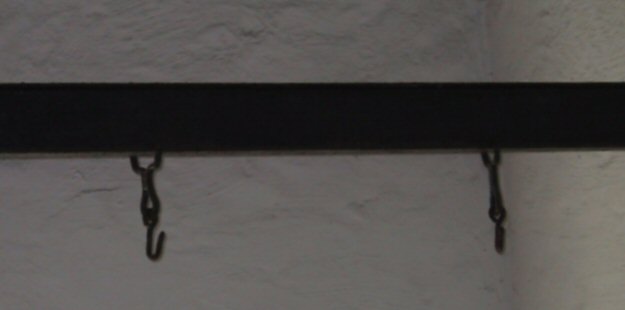
After getting an overview of the resistance a visit to the Plötzensee Prison Memorial, on the borders of Charlottenburg and Wedding, which can be reached by going to the Gedenkstätte Plötzensee S Bahn station, is where over 2,500 German political prisoners were executed between January and April 1945. Many of these people were Christians who were literally hung on huge meat hooks where they slowly bled or strangled to death.

The hooks used to execute prisoners.
The nearby Church of Mary Queen of the Martyrs, or Kirche Maria Regina Martyrum, was designed by Hans Scäde as a memorial to victims of Nazi oppression. It is entered through a courtyard representing the parade ground in a concentration camp, which symbolizes pain and suffering. The crypt is deliberately gloomy, but the upper church is illuminated by a gentle, natural light, and contains a large modern fresco by Georg Meistermann depicting the transformation of darkness into light, night to day, evil to goodness, through the redemption of Christ. Note the 14th-century Madonna in the church and the modern sculpture “The Woman of the Apocalypse” by F. König in the courtyard. Overall this church makes a deep impact on its visitors reminding them of the great suffering of Jews and Christians during the Nazi era.

Mary of the Martyrs Church.
After visiting these sites a trip to the notorious Sachsenhausen concentration camp in Oranienburg, at the end of the south S-Bahn line, is appropriate. Here you can see the conditions under which political prisoners lived, including the cell of the famed theologian Martin Niemöller (1892-1984), who was held there “at Hitler’s pleasure” for his bold criticisms of Nazism. It is also important to realize that, after 1945, Sachsenhausen became an equally brutal Soviet prison under Communist control. The full story of the Communist use of former concentration camps, where thousands of people died, many of whom were not Nazis at all, has yet to be told.

Saturday, January 15, 2011

Jewish Berlin

I posted thought I had published this blog last week, but somehow it went to the Christian Book Reviews Blog - can I blame Microsoft Gremlins? Anyway here it is where it is supposed to be:

Although to anyone who has never visited Berlin the idea of a “Jewish Berlin,” may sound absurd, Judaism is actually an important and vibrant tradition that the Nazis failed to eradicate. Perhaps the best place to start a tour of Jewish Berlin is with a visit to the well designed Jewish Museum opened in September 2001 and designed by the American architect Daniel Libeskind (b. 1946). This is a masterpiece of design that captures the tragedy of the Holocaust while preserving a sense of both history and hope. More information can be found on the museum’s excellent website at:

Another place to visit is the Neue Synagogue (New Synagogue), Oranienburger Str. 30, near Museuminsel. It can be found on the web at:


Completed in 1866, it was designed by the architects Eduard Knoblauch and Friedrich August Stüler (1800 – 1865) and built as an impressive example of Romantic architecture in Moorish style. Badly damaged in World War II, the church was reconstructed beginning in 1988. Attacked during Kristallnacht in 1938, the Synagogue was saved from destruction by the local police chief. A plaque on its outside wall remembers his courageous act. Today the New Synagogue is now the main center for Berlin’s Jewish community.

One of the fascinating things about Berlin is its well preserved cemeteries. The Jüdischer Friedhof (Jewish cemetery), Grosse Hamburger Strasse, founded in 1672 is the oldest in Berlin. It once contained the grave of the philosopher Moses Mendelssohn (1729-1786), the grandfather of the composer Felix Mendelssohn-Bartholdy (1809-1847). Felix Mendelssohn-Bartholdy’s conversion to Christianity is commemorated in his great oratorio Paulus (St. Paul).

The graveyard was desecrated by the Gestapo in 1942. Now all you can see is a memorial plaque, a bronze sculpture by Will Lambert dedicated to the 55,000 Berlin Jews who were deported to camps in the East, and a gravestone commemorating Moses Mendelssohn who was on of the greatest Jewish philosophers of all time.

The Jüdischer Friedhof (Jewish Cemetery), Senefelderplatz, Pankow, fared better than most. It contains the graves of the composer Giacomo Meyerbeer (1791 – 1864), the historian Richard Moritz Meyer (1860-1914), and the painter Max Liebermann (1847-1935).